








| Forthcoming
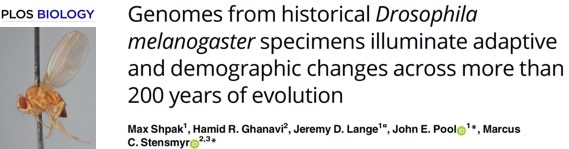
Papers: (underline = Pool lab member; * = equal contributions) Miranda VH, da Silva Ribeiro T, Alves JM, Eanes W, Brud E, Veeramah K, Pool JE, Rodrigues MF, Cogni R (2026) Gene flow weakens genomic clines while selection maintains adaptive loci: two decades of evolution in Drosophila melanogaster natural populations. bioRxiv. LINK Pelletier K, Bilodeau M, Pellizzari-Delano, I, Siemon MD, Huang Y, Pool JE, Dworkin IE (2026) Polygenic architecture of adaptation to a high-altitude environment for Drosophila melanogaster wing shape and size. bioRxiv. LINK All Published/Accepted Papers: (underline = Pool lab member; * = equal contributions) McAllester CS, Pool JE (2025) The potential of inversions to accumulate balanced sexual antagonism is supported by simulations and Drosophila experiments. eLife, 12:RP93338. PDF Shpak M, Lawrence KD, Pool JE (2025) The precision and power of population branch statistics in identifying the genomic signatures of local adaptation. Genome Biol Evol 17:evaf080. PDF da Silva Ribeiro T, Lollar MJ, Sprengelmeyer QD, Huang Y, Benson DM, Orr MS, Johnson ZC, Corbett-Detig RB, Pool JE (2025) Recombinant inbred line panels inform the genetic architecture and interactions of adaptive traits in Drosophila melanogaster. G3 15:jkaf051. PDF Lollar MJ, Kim E, Stern DL, Pool JE (2025) Courtship song differs between African and European populations of Drosophila melanogaster and involves a strong effect locus. G3 15:jkaf050. PDF Feng S, DeGrey SP, Guedot C, Schoville SD, Pool JE (2024) Genomic diversity illuminates the species history and environmental adaptation of Drosophila suzukii. Genome Biol Evol 16:evae195 PDF Shpak M, Ghanavi HR, Lange JD, Pool JE, Stensmyr MC (2023) Genomes from 25 historical Drosophila melanogaster specimens illuminate adaptive and demographic changes across more than 200 years of evolution. PLOS Biol, 21(10): e3002333. PDF Lollar MJ, Biewer-Heisler TJ, Danen CE, Pool JE (2023) Hybrid breakdown in male reproduction between recently-diverged Drosophila melanogaster populations has a complex and variable genetic architecture. Evolution, 77:1550-1563. PDF Lange JD, Bastide H, Lack JB, Pool JE (2022) A population genomic assessment of three decades of evolution in a natural Drosophila population. Mol Biol Evol, 39:msab368. PDF Duranton M, Pool JE (2022) Interactions between natural selection and recombination shape the genomic landscape of introgression. Mol Biol Evol, 39:msac122. PDF da Silva Ribeiro T, Galván JA, Pool JE (2022) SNP-level FST outperforms whole-window statistics for detecting soft sweeps in local adaptation. Genome Biol Evol, 14:evac143. PDF Sprengelmeyer QD, Lack JB, Braun DT, Monette MJ, Pool JE (2022) The evolution of larger size in high altitude Drosophila melanogaster has a polymorphic genetic architecture. G3, 12:jkab454. PDF Huang Y, Lack JB, Hoppel GT, Pool JE (2022) Gene regulatory evolution in cold-adapted fly populations neutralizes plasticity and may undermine genetic canalization. Genome Biol Evol, 14:evac050. PDF Huang Y, Lack JB, Hoppel GT, Pool JE (2021) Parallel and Population-specific Gene Regulatory Evolution in Cold-Adapted Fly Populations. Genetics, 218:iyab077. PDF Sprengelmeyer QD, Pool JE (2021) Ethanol resistance in Drosophila melanogaster has increased in parallel cold-adapted populations and shows a variable genetic architecture within and between populations. Ecol Evol, 11:15364–15376. PDF Machado HE*, Bergland AO*, Taylor R, Tilk S, Behrman E, Dyer K, Fabian DK, Flatt T, González J, Karasov TL, Kim B, Kozeretska I, Lazzaro BP, Merritt TJS, Pool JE, O’Brien K, Rajpurohit S, Roy PR, Schaeffer SW, Serga S, Schmidt P, Petrov DA (2021) Broad geographic sampling reveals the shared basis and environmental correlates of seasonal adaptation in Drosophila. eLife, 10:e67577. PDF Sprengelmeyer QS, Mansourian S, Lange JD, Matute DR, Cooper BS, Jirle EV, Stensmyr MC, Pool JE (2020) Recurrent collection of Drosophila melanogaster from wild African environments and genomic insights into species history. Mol Biol Evol, 37:627-638. PDF Mansourian S, Engin A, Jirle EV, Ramesh V, Rehermann G, Becher PG, Pool JE, Stensmyr MC (2018) Wild African Drosophila melanogaster are seasonal specialists on marula fruit. Curr Biol, 28:3960-3968. PDF Lange JD, Pool JE (2018) Impacts of recurrent hitchhiking on divergence and demographic inference in Drosophila. Genome Biol Evol, 10:1882-1891. PDF Groth BR*, Huang Y*, Monette MJ, Pool JE (2018) Directional selection reduces developmental canalization against genetic and environmental perturbations in Drosophila wings. Evolution, 72:1708-1715. PDF Pool JE, Braun DT, Lack JB (2017) Parallel evolution of cold tolerance within Drosophila melanogaster. Mol Biol Evol, 34:349-360. PDF Hervas S, Sanz E, Casillas S, Pool JE, Barbadilla A (2017) PopFly: the Drosophila population genomics browser. Bioinformatics, 33:2779–2780. PDF Bastide H, Lange JD, Lack JB, Yassin A, Pool JE (2016) A variable genetic architecture of melanic evolution in Drosophila melanogaster. Genetics, 204:1295-1306. PDF Pool JE (2016) Genetic mapping by bulk segregant analysis in Drosophila: experimental design and simulation-based inference. Genetics, 204:1295-1306. PDF Lack JB, Lange JD, Tang AD, Corbett-Detig RB, Pool JE (2016) A thousand fly genomes: an expanded Drosophila Genome Nexus. Mol Biol Evol, 33:3308-3313. PDF Lack JB, Monette MJ, Johanning EJ, Sprengelmeyer QD, Pool JE (2016) Decanalization of wing development accompanied the evolution of large wings in high altitude Drosophila. Proc Natl Acad Sci USA 113:1014-1019. PDF Lack JB, Yassin A, Johanning EJ, Sprengelmeyer QD, David JR, Pool JE (2016) Life history evolution and cellular mechanisms associated with increased size in high altitude Drosophila. Evol Ecol 6:5893-5906. PDF Yassin A, Debat V, Bastide H, Gadesweski N, David JR*, Pool JE* (2016) Recurrent specialization on a toxic fruit in an island Drosophila population. Proc Natl Acad Sci USA 113:4771-4776. PDF Yassin A, Bastide H, Chung H, Veuille M, David JR, Pool JE (2016) Ancient balancing selection at tan underlies female color dimorphism in Drosophila erecta. Nat Commun 7:10400. PDF Yassin A*, Delaney EK*, Reddieux A, Bastide H, Appleton N, Seher T, Podlaja O, Lack JB, Barmina O, Allen S, David JR, Chenoweth S, Pool JE, Kopp A (2016) Pdm3 is responsible for recurrent evolution of female-limited color dimorphism in Drosophila. Curr Biol, 26:2412-2422. PDF Lange JD, Pool JE (2016) A haplotype method detects diverse scenarios of local adaptation from genomic sequence variation. Mol Ecol 25:3081-3100. PDF Gasch AP, Payseur BA, Pool JE (2016) The power of natural variation for model organism biology. Trends Genet 32:147-154. PDF Pool JE (2015) The mosaic ancestry of the Drosophila Genetic Reference Panel and the D. melanogaster reference genome reveals a network of epistatic fitness interactions. Mol Biol Evol 32:3236-3251. PDF Lack JB, Cardeno CM, Crepeau MW, Taylor W, Corbett-Detig RB, Stevens KA, Langley CH, Pool JE (2015) The Drosophila Genome Nexus: a population genomic resource of 623 Drosophila melanogaster genomes, including 197 from a single ancestral range population. Genetics, 199:1229-1241. PDF Fabian DK, Lack JB, Vinayak M, Schlötterer C, Schmidt PS, Pool JE, Flatt T (2015) Spatially varying selection shapes life history clines among populations of Drosophila melanogaster from sub-Saharan Africa. J Evol Biol 28:826-840. Bastide H*, Yassin A*, Johanning EJ, Pool JE (2014) Pigmentation in Drosophila melanogaster reaches its maximum in Ethiopia and correlates most strongly with ultra-violet radiation in sub-Saharan Africa. BMC Evol Biol 14:179. PDF Pitchers W, Pool JE, Dworkin I (2013) Altitudinal clinal variation in wing size and shape in African Drosophila melanogaster: one cline or many? Evolution 67:438-452. PDF Hua Z, Pool JE, Schmitz RJ, Schultz MD, Shiu S-H, Ecker JR, Vierstra RD (2013) Epigenomic programming contributes to the genomic drift evolution of the F-Box protein superfamily in Arabidopsis. Proc Natl Acad Sci USA 110:16927-16932. Pool JE, Corbett-Detig RB, Sugino RP, Stevens KA, Cardeno CM, Crepeau MW, Duchen P, Emerson JJ, Saelao P, Begun, DJ, Langley CH (2012) Population genomics of sub-Saharan Drosophila melanogaster: African diversity and non-African admixture. PLoS Genetics 8:e1003080. PDF Supplement Pool Publications: (pre-UW) Langley CH, Stevens KA, Cardeno C, Lee Y-C, Schrider D, Pool JE, Langley S, Suarez C, Corbett-Detig R, Kolaczkowski B, Kern AD, Dewey CN, Song Y, Hahn MW, Begun DJ (2012) Population genomics of Drosophila melanogaster. Genetics 192:533-598. PDF Wang L, Luzynski K, Pool JE, Janoušek V, Dufkova P, Mrkvicová Vyskočilová M, Teeter K, Nachman M, Munclinger P, Macholan M, Pialek J, Tucker PK (2011) Measures of linkage disequilibrium among neighboring SNPs indicate asymmetries across the house mouse hybrid zone. Mol Ecol 14:2985-3000. Yi X*, Liang Y*, Huerta-Sanchez E*, Jin X*, Cuo ZXP*, Pool JE*, et al. (2010) Sequencing of fifty human exomes reveals adaptation to high altitude. Science 329:75-78. PDF1 PDF2 Pool JE, Hellmann I, Jensen JD, Nielsen R (2010) Population genetic inference from genomic sequence variation. Genome Res 20:291-300. PDF Rebeiz M, Pool JE, Kaessner V, Aquadro CF, Carroll SB (2009) Stepwise modification of a modular enhancer underlies local adaptation in a Drosophila population. Science 326:1663-1667. PDF1 PDF2 Pool JE, Nielsen R (2009) Inference of historical changes in migration rate from the lengths of migrant tracts. Genetics 181:711-719. PDF Wang J, et al. (2008) The diploid genome sequence of an Asian individual. Nature 456:60-65. Pool JE, Nielsen R (2008) The impact of founder events on chromosomal variability in multiply mating species. Mol Biol Evol 25:1728-1736. PDF Pool JE, Nielsen R (2007) Population size changes reshape genomic patterns of diversity. Evolution 62:3001-3006. PDF1 PDF2 Pool JE, Aquadro CF (2007) The genetic basis of adaptive pigmentation variation in Drosophila melanogaster. Mol Ecol 16:2844-2851. PDF1 PDF2 Wong A, Jensen JD, Pool JE, Aquadro CF (2007) Phylogenetic incongruence in the Drosophila melanogaster species group. Mol Phyl Evol 43:1138-1150. Pool JE, Aquadro CF (2006) History and structure of sub-Saharan populations of Drosophila melanogaster. Genetics 174:915-929. PDF Pool JE, Wong A, Aquadro CF (2006) Finding of male-killing Spiroplasma infecting Drosophila melanogaster in Africa implies transatlantic migration of this endosymbiont. Heredity 97:27-32. PDF Pool JE, Bauer DuMont V, Mueller JL, Aquadro CF (2006) A scan of molecular variation leads to the narrow localization of a selective sweep affecting both Afrotropical and cosmopolitan populations of Drosophila melanogaster. Genetics 172:1093-1105. PDF |